
What is the Engineering Process Behind Support of Excavation (SOE) for Infrastructure Projects?
Engineering in Support of Excavation: Building Down Before Building Up
TL;DR
Before any major infrastructure project takes shape above ground, the real engineering challenge happens below the surface. This article walks you through the engineering process behind support of excavation for infrastructure projects. It takes you inside the hidden world of excavation support where engineers study soil, model forces, and design systems to safely hold back the earth while construction unfolds. It breaks down how careful planning, collaboration, and constant monitoring prevent even miniscule movement from turning into major risks. If you have ever wondered how deep subway stations, shafts, or urban builds happen without damaging everything around them, this is a fascinating look at the invisible work that makes it all possible and why getting the ground right is what allows everything above it to stand.
Table of Contents
▲- Introduction: Building Down Before Building Up
- Understanding the Need for Support of Excavation (SOE)
- The Story Begins in the Soil: Interpreting Geotechnical Reports
- Turning Soil Into Numbers: Load Calculations and Modelling
- Choosing the Right System: Bracing vs Anchoring
- Engineering in Action: Types of Excavation Support Systems
- Collaboration Across Disciplines in SOE Projects
- Monitoring and Instrumentation: Ensuring Real-Time Safety
- Risk Mitigation: Designing for the Unknown
- From Excavation to Infrastructure: Why SOE Matters
- Closing Reflection: Engineering Below Ground
- FAQ – What is the Engineering Process behind SOE
Table of Contents
Introduction: Building Down Before Building Up
Before the first excavator arrives, the site already carries weight.
It might be a downtown transit expansion. Traffic moves overhead. Pedestrians pass without noticing what is about to happen below their feet. Beneath the asphalt lie water mains, electrical ducts, fibre optic lines, and aging utilities layered over decades. On either side, buildings stand only metres away. Some are modern towers. Others are century-old masonry structures that were never designed for nearby deep excavation.
Soon, the ground will be opened.
In many urban transit projects, excavations reach depths of 15 to 30 metres, sometimes deeper. That is the height of a 10-storey building turned upside down into the earth. The soil must stand vertically. It must resist lateral earth pressure, which is the sideways force soil exerts when it is cut. It must remain stable despite groundwater, surface loads from traffic, and the weight of neighbouring structures.
There is no room for excessive movement. Even a few millimetres of ground displacement can affect adjacent utilities. A few more can crack foundations or disrupt rail lines. In dense urban environments, tolerance for error is extremely low.
Understanding the Need for Support of Excavation (SOE)
To the public, the excavation may look like the first visible step in building a subway station or a waterworks shaft. In reality, it is the result of months of engineering preparation.
Before excavation begins, the real work starts. The role of engineering in support of excavation begins. And it starts not in the field, but in the data.
The Story Begins in the Soil: Interpreting Geotechnical Reports
Before any excavation begins, engineers start with something far less visible than steel or concrete. They start with soil data.
A geotechnical report is essentially a detailed story about what lies beneath the surface. It is built from field investigations, lab testing, and careful interpretation. The process usually begins with boreholes drilled at planned locations across a site. Each borehole log records soil type, depth, moisture, and changes in material. Think of it as a vertical snapshot of the ground.
During drilling, engineers often perform:
- Standard Penetration Tests (SPT), which measure how many hammer blows are needed to drive a sampler into the soil. The result gives insight into soil density and strength.
- Cone Penetration Testing (CPT), where a steel cone is pushed into the ground while sensors measure resistance. This provides continuous data about soil strength and layering.
Groundwater levels are also recorded carefully. Even small changes in the water table can affect excavation stability, uplift pressure, and seepage.
The geotechnical report defines soil stratigraphy, which simply means the layering of soils. Sand may sit over clay. A (land) fill may rest above natural ground. Each layer behaves differently when loaded.
Laboratory testing adds more detail. Engineers determine:
- Cohesion, which reflects how strongly soil particles stick together.
- Friction angle, which represents resistance created by particle interlock.
- Unit weight, which is the weight of soil per unit volume.
These values feed directly into earth pressure calculations.
Interpretation is where expertise matters most. Soil is not uniform. Two boreholes ten metres apart can produce very different results. That difference can significantly change predicted wall movement and support forces.
Engineers also assess consolidation potential, which is the tendency of soil, especially clay, to compress over time. They calculate lateral earth pressure coefficients which describe how soil pushes against a retaining wall under different conditions. Hydrostatic pressure from groundwater is also evaluated.
Design decisions are guided by recognized standards such as the Canadian Foundation Engineering Manual. These standards provide structure. Engineering judgment brings them to life. Geotechnical engineering in support of excavation sets up the foundation of a successful project.
At this stage, the excavation exists only on paper. But the soil profile and groundwater conditions have already begun shaping the entire support system.
Turning Soil Into Numbers: Load Calculations and Modelling
Once engineers understand the soil, the next step is turning that information into numbers.
Soil behaviour must be translated into forces. Those forces act on retaining walls, struts, anchors, and foundations. Every value must be supported by established theory and recognized standards.
When soil is excavated, it pushes sideways against the retaining system. This is called lateral earth pressure. The amount of pressure depends on how much the wall moves.
Engineers also account for surcharge loads, which are additional loads at the surface. These may include traffic, equipment, stockpiled materials, or adjacent structures. In seismic regions, methods such as Mononobe Okabe are used to estimate earthquake induced pressures.
Water adds complexity. Hydrostatic pressure increases with depth. Groundwater can increase wall demand, create uplift at the base of the excavation, and generate seepage forces that reduce soil strength.
Once all load cases are defined, the structural system is modelled.
Engineers build analytical models of:
- Retaining walls
- Horizontal struts
- Walers and connection points
They calculate bending moments, shear forces, and wall deflection. Even a few millimetres of movement can affect nearby utilities or foundations.
Finite Element Modelling, or FEM, is often used in this process. FEM divides the wall and soil into many small elements and simulates how the system behaves through staged excavation.
What appears on site as a single steel strut is actually the result of thousands of load combinations tested digitally. By this stage, the numbers define the required strength, stiffness, and layout of the support system.
Those numbers ultimately drive system selection.
The Critical Decision: Bracing or Anchoring for Earth Retention?
Once engineers understand the loads and predicted wall movements, they face a key question. How should the excavation be supported? With internal bracing or with external anchors?
This decision affects everything.
- Construction sequencing.
- Site access.
- Cost control.
- Long term performance.
Internal bracing means installing structural members inside the excavation. Common components include:
- Cross lot struts, which are horizontal steel members that span from one side of the excavation to the other. They resist soil pressure by working in compression.
- Rakers, which are inclined supports that transfer load from the wall down to a slab or footing.
- Walers, which are horizontal beams attached to the wall to distribute loads evenly.
These systems are installed in stages as excavation deepens. After each lift of soil is removed, a new level of bracing is added. This staged approach helps control wall movement, which is critical when nearby buildings can tolerate only minimal settlement.
The advantage is control. The trade off is space.
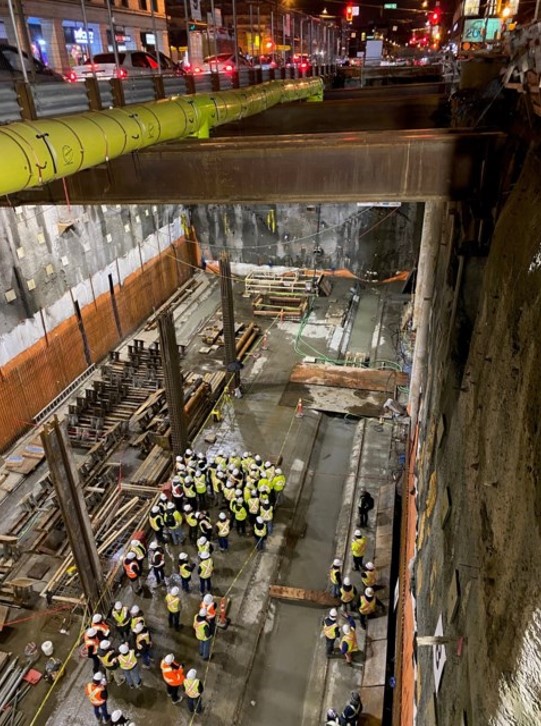
Engineering in Action: Types of Excavation Support Systems
Struts and rakers can obstruct equipment and material handling. Installation must be carefully coordinated with excavation progress. Tieback anchors offer a different solution. Instead of bracing across the excavation, anchors extend outward into the surrounding soil or rock. They are drilled and grouted into place. Each anchor has a bonded length, which transfers load to stable ground, and a free length, which allows the steel tendon to stretch when tensioned.
Anchors keep the excavation open, which is ideal for wide sites or deep shafts. However, soil conditions, property boundaries, and underground easements must allow their installation.
The choice is rarely about cost alone. It depends on soil behaviour, structural demands, site geometry, construction logistics, and regulatory constraints. What looks like a simple option on paper is actually a multidisciplinary engineering judgment. With an experience spanning decades, infraMOD uses its experience of engineering in support of excavation projects to provide site specific customized solutions that include both struts, walers and ground anchoring solutions like tie backs.
The final system that’s chosen reflects both the ground conditions and the project’s long term goals.
Engineering Is Never Isolated: Collaboration Across Disciplines
Support of Excavation is never a one team effort. It is a coordinated process built around one shared goal. Stability.
There are 4 main disciplines that impact engineering in support of excavation projects.
- Geotechnical engineers start with the ground. They interpret soil strength, groundwater levels, and how the soil is likely to move during excavation.
- Structural engineers take those pressures and turn them into physical systems. They size struts, walers, and anchors.
- Construction teams add another critical layer. They understand how work actually happens on site. They advise on sequencing, equipment access, lift heights, and installation tolerances. A design that works on paper must also work in the field.
- Survey and monitoring specialists close the loop between prediction and performance.
Before excavation begins, an instrumentation plan is created. It defines what will be monitored and how often. Typical instruments include:
- Inclinometers, which measure lateral ground movement
- Settlement markers, which track vertical movement at the surface
- Load cells, which measure force in struts or anchors
Monitoring and Instrumentation: Ensuring Real-Time Safety
Monitoring thresholds are set in advance. These are predefined movement or load limits. If readings approach a trigger value, the team responds. Excavation may pause. Additional support may be installed.
For non-technical readers, this means excavation is constantly checked against expectations. For engineers, it means models are validated in real time.
Engineering in support of excavation is not design once and forget. It evolves. And it succeeds because disciplines work together, balancing calculation with observation at every stage.
Risk Mitigation: Designing for the Unknown
But then, no soil model is perfect. So, there is inherent risk.
Boreholes give us samples from specific points. Lab tests measure strength under controlled conditions. Computer models simulate behaviour using defined assumptions. But the ground is still a natural material. It varies across a site. It can behave differently than predicted.
Good engineering in support of excavation projects does not ignore that uncertainty. It plans for it.
In practice, this means engineers clearly define:
- Expected wall deflection ranges
- Allowable settlement limits
- Anticipated anchor or strut loads
- Specific actions if those limits are approached
Another layer of protection is the factor of safety. This is the ratio between how much load a system can resist and how much load it is expected to carry. If a brace can resist twice the predicted force, the factor of safety is two.
Redundancy is also built into many systems. Multiple struts. Staged supports. Conservative spacing. The goal is to avoid reliance on a single element.
Contingency planning is done before excavation begins. Teams identify potential responses such as adding supports, adjusting sequencing, or implementing ground improvement methods like jet grouting or soil mixing if weaker soils are encountered.
Designs are reviewed internally. Major projects often undergo independent peer review. Safety compliance is mandatory.
This way risk is managed proactively. For engineers working on earth retention projects, it reflects a disciplined process grounded in standards and measurement.
Designing for the unknown does not mean guessing. It means preparing, monitoring, and building margin into every decision.
From Excavation to Infrastructure: The Invisible Contribution of Engineering in SOE
Months after the first borehole is drilled, the transformation is visible.
A subway station begins to rise above ground. Concrete slabs are poured. Steel frames take shape. Soon, commuters will move through platforms that did not exist a year ago. At another site, a deep waterworks shaft is complete. Pumps are running. Treatment systems are online. Clean water flows to surrounding communities.
The infrastructure is now tangible. It becomes part of daily life. What is no longer visible is the system that made it possible. The bracing frames have been removed. Struts and walers are dismantled. Temporary anchors are cut and capped. The active support system that once held back thousands of tonnes of soil is gone. Yet every stage of construction depended on it.
Without controlled wall deflection, nearby buildings could have settled or cracked. Without groundwater control, hydrostatic pressure could have destabilized the base of the excavation. Without staged support installation, bending and shear forces in the retaining wall could have exceeded safe limits.
Support of Excavation systems are classified as temporary works. They are installed for construction and often removed once permanent structures are complete. But temporary does not mean minor. If an excavation support system underperforms, the consequences can include delays, cost overruns, or structural damage.
For most, excavation may seem like an early step that’s not very important. For engineers, it is one of the highest risk phases of a project. Support of Excavation / earth retention activities may be temporary in duration. Its impact is permanent. The success of the finished station or water facility depends on decisions made long before the structure became visible.
Often, the most important engineering work is the work you never see.
Closing Reflection: Engineering Below Ground
Engineering is often celebrated for what we can see.
Bridges crossing rivers. Transit stations anchoring busy city blocks. Water treatment plants quietly protecting public health. These structures shape skylines and serve communities for decades. But true structural stability does not begin with steel rising into the sky. It begins below ground.
Long before concrete is poured, engineers study borehole logs and lab results. They interpret shear strength parameters, groundwater conditions, and earth pressure coefficients. They work to understand how soil will behave when it is cut, supported, and exposed.
Modern geotechnical practice accepts a simple truth. The ground is variable. It carries uncertainty.
This is where disciplined engineering matters most.
It involves:
- Gathering reliable site data
- Calculating loads carefully
- Building and testing analytical models
- Defining deflection limits
- Establishing monitoring plans before excavation begins
Uncertainty is not ignored. It is translated into clear load cases, safety factors, and contingency plans. That translation is what turns soil variability into structural reliability.
This means the ground beneath a project is never assumed to be uniform or predictable.
infraMOD operates at this intersection of data and discipline. Engineering led decision making guides system selection. Data driven analysis supports every calculation. A structured process governs modelling, monitoring, and review. Before a station opens. Before a shaft becomes operational. Before a structure becomes part of the skyline. Stability has already been engineered below ground. It is that unseen discipline that allows visible infrastructure to stand the test of time.
How infraMOD can help with Engineering
infraMOD brings over 35 years of experience delivering practical, construction-focused engineering solutions across complex infrastructure projects. Our approach combines detailed project analysis, close stakeholder coordination, and design innovation to develop efficient and buildable solutions.
We are leaders in excavation support engineering, specializing in earth retention systems such as bracing, shoring, and temporary works design. Our deep understanding of ground conditions, construction sequencing, and site constraints allows us to develop designs that are not only technically sound but also optimized for execution.
By working closely with clients, contractors, and project teams, we provide engineering solutions that are tailored to the realities of each project. Whether it is optimizing system selection, improving constructability, or reducing risk during excavation, our focus remains on delivering solutions that add value and help control cost and schedule.
See what our customers have to say about working with us and contact us today to learn how infraMOD can support your next project with engineering solutions that are practical, efficient, and built for real-world conditions.
Frequently Asked Questions (FAQ)
Support of Excavation (SOE) refers to the systems and engineering methods used to keep soil stable during deep digging for infrastructure projects.
In simple terms, SOE involves:
- Preventing soil collapse during excavation
- Controlling ground movement near structures
- Managing groundwater pressure
- Protecting nearby utilities and buildings
- Ensuring safe working conditions on site
In dense urban environments, even small ground movements can cause serious damage.
SOE is critical because it:
- Prevents cracks or settlement in nearby buildings
- Protects underground utilities like pipes and cables
- Maintains stability under traffic and surface loads
- Reduces risk of costly delays or structural failure
- Ensures compliance with safety standards
Engineers rely on geotechnical investigations to understand what lies beneath the surface.
This process typically includes:
- Drilling boreholes to study soil layers
- Conducting Standard Penetration Tests (SPT)
- Performing Cone Penetration Tests (CPT)
- Measuring groundwater levels
- Running lab tests for strength and density
Key soil properties analyzed:
- Cohesion (how well soil sticks together)
- Friction angle (resistance between particles)
- Unit weight (soil weight per volume)
Excavation design is driven by understanding the forces acting on the soil and support systems.
Main forces include:
- Lateral earth pressure (sideways soil force)
- Surcharge loads (traffic, equipment, nearby structures)
- Hydrostatic pressure (water pressure in soil)
- Seepage forces that weaken soil strength
Seismic loads in earthquake-prone areas
Engineers typically choose between internal and external support systems.
Internal bracing systems include:
- Cross-lot struts (horizontal supports)
- Rakers (angled supports)
- Walers (horizontal beams distributing load)
External systems include:
- Tieback anchors drilled into surrounding soil or rock
The choice depends on:
- Soil conditions
- Site space constraints
- Construction sequencing
Cost and long-term performance
Excavation is continuously monitored to ensure real-world behaviour matches design predictions.
Monitoring systems include:
- Inclinometers to track ground movement
- Settlement markers for surface movement
- Load cells to measure forces in supports
Engineers also:
- Set predefined safety thresholds
- Pause work if limits are approached
- Adjust support systems when needed
Excavation carries inherent uncertainty due to variable soil conditions.
Key risks include:
- Unexpected soil behaviour
- Excessive wall movement
- Groundwater pressure issues
- Settlement affecting nearby structures
- Structural overload of support systems
Mitigation strategies include:
- Using safety factors in design
- Adding redundancy (multiple supports)
- Planning contingency actions
- Conducting peer reviews and monitoring
Support of Excavation is a multidisciplinary effort.
Key teams involved:
- Geotechnical engineers (soil behaviour)
- Structural engineers (support design)
- Construction teams (execution and sequencing)
- Monitoring specialists (performance tracking)
Collaboration ensures:
- Designs are practical and buildable
- Risks are identified early
- Adjustments can be made in real time
Most SOE systems are temporary, but their impact is long-lasting.
Typically:
- Installed during construction
- Removed once permanent structures are built
However, they are critical because:
- They prevent structural damage during construction
- They ensure project timelines and budgets stay on track
- They enable safe completion of deep infrastructure
The success of visible infrastructure depends entirely on what happens underground.
Key reasons include:
- Stability begins with soil behaviour
- Early decisions shape the entire project outcome
- Proper planning reduces long-term risks
- Hidden engineering ensures visible success
In essence:
The most important engineering work is often the part you never see.