
Ontario Line Case Study
Home / Ontario Line Case Study
Case Study
infraMOD’s modular waler and strut systems transformed complex excavation support challenges into predictable, efficient solutions across eight major Toronto transit stations.
$100M
Contract Value
Total project value for modular systems
8
Major Stations
Major Stations
Ontario Line
$1MILLION
SAVED.
Just on one station!
Just on one station!
Ontario Line
Project Summary
The Ontario Line is one of the largest transit infrastructure projects in Canada, connecting Toronto communities with faster and more reliable transit. Stretching over nearly 16 kilometers with 15 new stations, the line is designed to relieve congestion, reduce commute times, and expand access across the city.
Our clients were tasked with delivering several downtown stations and emergency services buildings, each requiring deep excavations supported by temporary waler and strut systems to stabilize surrounding ground and protect nearby infrastructure.
infraMOD was awarded more than $100M in contracts to design, fabricate, and install our modular decking and bracing systems at key locations, including Exhibition Portal, King Bathurst, Queen Spadina, Osgoode, Queen, Moss Park, Corktown, Pape, and Sammon.
At each of these locations, we applied our unique methodology, which focuses on prefabricated modular solutions that reduce site activity, simplify installation, reduce total installed cost, and minimize project risk.
Strategic Location
16 kilometers connecting Toronto communities with 15 new stations
KEY PARTNERSHIP
Collaborated with our client for downtown station delivery
infraMOD™ Methodology
Prefabricated modular solutions reducing site activity and project risk
Project Breakdown by Location
infraMOD designed and delivered our modular bracing and decking systems across eight major excavations, each with unique challenges and requirements for deep excavation support.
LOCATION
Exhibition Place
TYPE
Infrastructure - Support of Excavation and Overhead Protection
TONNAGE
2,700
Exhibition – Exhibition Place serves as the southern terminal for the Ontario Line. The station, located at Exhibition GO Station, will be a key transit hub for the Ontario Line, GO Transit, and the TTC, offering direct access to the CNE and other events. Construction is underway to transform the existing GO Station into this integrated transit hub.
infraMOD Scope
- Supply and Logistics Management of Piling Materials
- Design, Supply, Fabrication, Testing, Painting, and Delivery of Permanent (Painted) Walers & Struts
- Design, Supply, Fabrication, Testing, and Delivery of Temporary Walers & Struts
- Design, Supply, Fabrication, Testing, Painting, and Delivery of Overhead Protection Structure
- Supply of Anchor Bolts
LOCATION
King Bathurst
TYPE
Infrastructure - Support of Excavation
TONNAGE
2,575
King Bathurst – In the heart of Toronto’s Fashion District, the station at King and Bathurst will create valuable connections between the Ontario Line and the popular 504 King and the 511 Bathurst streetcar routes.
inframod Scope
- Supply, Prefabrication, and Logistics Management of Piling Materials
- Design, Supply, Fabrication, Testing, and Delivery of Temporary Walers & Struts
LOCATION
Queen Spadina
TYPE
Infrastructure - Support of Excavation
TONNAGE
2,468
Queen Spadina – Queen-Spadina station is a planned subway station located at the intersection of Queen Street West and Spadina Avenue and will connect the Ontario Line with the 510 Spadina streetcar route, while also serving as a Transit-Oriented Community to provide new housing, jobs, and retail.
infraMOD Scope
- Supply, Prefabrication, and Logistics Management of Piling Materials
- Design, Supply, Fabrication, Testing, and Delivery of Temporary Walers & Struts
LOCATION
Osgoode
TYPE
Infrastructure - Support of Excavation and Decking
TONNAGE
1,102
Osgoode – Osgoode Station will provide a direct connection to the existing Line 1 Yonge-University subway. The expanded Osgoode station will incorporate new entrances at the University Avenue and Queen Street intersection, along with the existing historic facade of the building at 205 Queen St W.
infraMOD Scope
- Supply and Logistics Management of Piling Materials
- Design, Supply, Fabrication, Testing, and Delivery of Temporary Walers & Struts
- Design, Supply, Fabrication, Testing, and Delivery of Equipment Decking
LOCATION
Queen
TYPE
Infrastructure - Support of Excavation, Decking, and Utility Support in Place
TONNAGE
2,604
Queen – The Ontario Line will provide a vital transfer point with Line 1 at Queen Station, allowing customers to seamlessly transfer between the two lines to get to the heart of the city and beyond.
infraMOD Scope
- Supply and Logistics Management for Piling Materials
- Design, Supply, Fabrication, Testing, and Delivery of Temporary Walers & Struts
- Design, Supply, Fabrication, Testing, and Delivery of Equipment Decking, including Utility Supports
LOCATION
Moss Park
TYPE
Infrastructure - Support of Excavation
TONNAGE
1,345
Moss Park – Moss Park will host a station for the Ontario Line, a new 15.6 km subway in Toronto, with the station located at the corner of Sherbourne and Queen Street. Construction is underway, with excavation complete and the station poised to connect a large residential area to the subway network. The station is designed to relieve congestion on busy surface routes and bring more than 20,000 people within walking distance of rapid transit.
infraMOD Scope
- Supply and Logistics Management for Piling Materials
- Supply of Raw Beam and Pipe Materials for Temporary Walers & Struts
- Supply of Anchor Bolts
LOCATION
Corktown
TYPE
Infrastructure - Support of Excavation
TONNAGE
492
Corktown – Corktown Station is a planned station for the Ontario Line subway in Toronto, located at King Street East and Berkeley Street in the Corktown neighborhood. This station will connect to local streetcar and bus routes, including the 504 King streetcar and 65 Parliament bus. Construction is now underway on the Ontario Line, which includes Corktown Station as one of its 15 new stops connecting Exhibition Place to the Ontario Science Centre.
infraMOD Scope
- Supply and Logistics Management of Piling Materials
- Design, Supply, Fabrication, Testing, and Delivery of Temporary Walers & Struts
- Supply of Anchor Bolts
LOCATION
Pape
TYPE
Infrastructure - Support of Excavation
TONNAGE
4,571
Pape – Pape Station is a planned station for the Ontario Line subway in Toronto. It will be a major interchange station connecting to the TTC Line 2 Bloor-Danforth. Located north of Danforth Avenue, this station will reduce travel times to downtown to roughly 12 minutes, serve over 10,000 riders during peak hours, and significantly reduce crowding.
infraMOD Scope
- Design, Supply, Fabrication, Testing, and Delivery of Temporary Walers & Struts
LOCATION
Sammon Crossover
TYPE
Infrastructure - Support of Excavation
TONNAGE
940
infraMOD Scope
Sammon Crossover– The Sammon Emergency Services Building on the southeast corner of Pape Avenue and Sammon Avenue will be one of three emergency exit / emergency services buildings along the Ontario Line.
- Design, Supply, Fabrication, Testing, and Delivery of Temporary Walers & Struts
LOCATION
Exhibition Place
TYPE
Infrastructure - Support of Excavation and Overhead Protection
TONNAGE
2,700
Exhibition – Exhibition Place serves as the southern terminal for the Ontario Line. The station, located at Exhibition GO Station, will be a key transit hub for the Ontario Line, GO Transit, and the TTC, offering direct access to the CNE and other events. Construction is underway to transform the existing GO Station into this integrated transit hub.
infraMOD Scope
- Supply and Logistics Management of Piling Materials
- Design, Supply, Fabrication, Testing, Painting, and Delivery of Permanent (Painted) Walers & Struts
- Design, Supply, Fabrication, Testing, and Delivery of Temporary Walers & Struts
- Design, Supply, Fabrication, Testing, Painting, and Delivery of Overhead Protection Structure
- Supply of Anchor Bolts
LOCATION
King Bathurst
TYPE
Infrastructure - Support of Excavation
TONNAGE
2,575
King Bathurst – In the heart of Toronto’s Fashion District, the station at King and Bathurst will create valuable connections between the Ontario Line and the popular 504 King and the 511 Bathurst streetcar routes.
inframod Scope
- Supply, Prefabrication, and Logistics Management of Piling Materials
- Design, Supply, Fabrication, Testing, and Delivery of Temporary Walers & Struts
LOCATION
Queen Spadina
TYPE
Infrastructure - Support of Excavation
TONNAGE
2,468
Queen Spadina – Queen-Spadina station is a planned subway station located at the intersection of Queen Street West and Spadina Avenue and will connect the Ontario Line with the 510 Spadina streetcar route, while also serving as a Transit-Oriented Community to provide new housing, jobs, and retail.
infraMOD Scope
- Supply, Prefabrication, and Logistics Management of Piling Materials
- Design, Supply, Fabrication, Testing, and Delivery of Temporary Walers & Struts
LOCATION
Osgoode
TYPE
Infrastructure - Support of Excavation and Decking
TONNAGE
1,102
Osgoode – Osgoode Station will provide a direct connection to the existing Line 1 Yonge-University subway. The expanded Osgoode station will incorporate new entrances at the University Avenue and Queen Street intersection, along with the existing historic facade of the building at 205 Queen St W.
infraMOD Scope
- Supply and Logistics Management of Piling Materials
- Design, Supply, Fabrication, Testing, and Delivery of Temporary Walers & Struts
- Design, Supply, Fabrication, Testing, and Delivery of Equipment Decking
LOCATION
Queen
TYPE
Infrastructure - Support of Excavation, Decking, and Utility Support in Place
TONNAGE
2,604
Queen – The Ontario Line will provide a vital transfer point with Line 1 at Queen Station, allowing customers to seamlessly transfer between the two lines to get to the heart of the city and beyond.
infraMOD Scope
- Supply and Logistics Management for Piling Materials
- Design, Supply, Fabrication, Testing, and Delivery of Temporary Walers & Struts
- Design, Supply, Fabrication, Testing, and Delivery of Equipment Decking, including Utility Supports
LOCATION
Moss Park
TYPE
Infrastructure - Support of Excavation
TONNAGE
1,345
Moss Park – Moss Park will host a station for the Ontario Line, a new 15.6 km subway in Toronto, with the station located at the corner of Sherbourne and Queen Street. Construction is underway, with excavation complete and the station poised to connect a large residential area to the subway network. The station is designed to relieve congestion on busy surface routes and bring more than 20,000 people within walking distance of rapid transit.
infraMOD Scope
- Supply and Logistics Management for Piling Materials
- Supply of Raw Beam and Pipe Materials for Temporary Walers & Struts
- Supply of Anchor Bolts
LOCATION
Corktown
TYPE
Infrastructure - Support of Excavation
TONNAGE
492
Corktown – Corktown Station is a planned station for the Ontario Line subway in Toronto, located at King Street East and Berkeley Street in the Corktown neighborhood. This station will connect to local streetcar and bus routes, including the 504 King streetcar and 65 Parliament bus. Construction is now underway on the Ontario Line, which includes Corktown Station as one of its 15 new stops connecting Exhibition Place to the Ontario Science Centre.
infraMOD Scope
- Supply and Logistics Management of Piling Materials
- Design, Supply, Fabrication, Testing, and Delivery of Temporary Walers & Struts
- Supply of Anchor Bolts
LOCATION
Gerard
TYPE
Infrastructure - Support of Excavation
VALUE
$2-4.9 M
TONNAGE
3,000
LOCATION
Pape
TYPE
Infrastructure - Support of Excavation
TONNAGE
4,571
Pape – Pape Station is a planned station for the Ontario Line subway in Toronto. It will be a major interchange station connecting to the TTC Line 2 Bloor-Danforth. Located north of Danforth Avenue, this station will reduce travel times to downtown to roughly 12 minutes, serve over 10,000 riders during peak hours, and significantly reduce crowding.
infraMOD Scope
- Design, Supply, Fabrication, Testing, and Delivery of Temporary Walers & Struts
LOCATION
Cosburn
TYPE
Infrastructure - Support of Excavation
VALUE
$2-4.9 M
TONNAGE
3,000
LOCATION
Exhibition Place
TYPE
Infrastructure - Support of Excavation and Overhead Protection
TONNAGE
2,700
Exhibition – Exhibition Place serves as the southern terminal for the Ontario Line. The station, located at Exhibition GO Station, will be a key transit hub for the Ontario Line, GO Transit, and the TTC, offering direct access to the CNE and other events. Construction is underway to transform the existing GO Station into this integrated transit hub.
infraMOD Scope
- Supply and Logistics Management of Piling Materials
- Design, Supply, Fabrication, Testing, Painting, and Delivery of Permanent (Painted) Walers & Struts
- Design, Supply, Fabrication, Testing, and Delivery of Temporary Walers & Struts
- Design, Supply, Fabrication, Testing, Painting, and Delivery of Overhead Protection Structure
- Supply of Anchor Bolts
LOCATION
King Bathurst
TYPE
Infrastructure - Support of Excavation
TONNAGE
2,575
King Bathurst – In the heart of Toronto’s Fashion District, the station at King and Bathurst will create valuable connections between the Ontario Line and the popular 504 King and the 511 Bathurst streetcar routes.
inframod Scope
- Supply, Prefabrication, and Logistics Management of Piling Materials
- Design, Supply, Fabrication, Testing, and Delivery of Temporary Walers & Struts
LOCATION
Queen Spadina
TYPE
Infrastructure - Support of Excavation
TONNAGE
2,468
Queen Spadina – Queen-Spadina station is a planned subway station located at the intersection of Queen Street West and Spadina Avenue and will connect the Ontario Line with the 510 Spadina streetcar route, while also serving as a Transit-Oriented Community to provide new housing, jobs, and retail.
infraMOD Scope
- Supply, Prefabrication, and Logistics Management of Piling Materials
- Design, Supply, Fabrication, Testing, and Delivery of Temporary Walers & Struts
LOCATION
Osgoode
TYPE
Infrastructure - Support of Excavation and Decking
TONNAGE
1,102
Osgoode – Osgoode Station will provide a direct connection to the existing Line 1 Yonge-University subway. The expanded Osgoode station will incorporate new entrances at the University Avenue and Queen Street intersection, along with the existing historic facade of the building at 205 Queen St W.
infraMOD Scope
- Supply and Logistics Management of Piling Materials
- Design, Supply, Fabrication, Testing, and Delivery of Temporary Walers & Struts
- Design, Supply, Fabrication, Testing, and Delivery of Equipment Decking
LOCATION
Queen
TYPE
Infrastructure - Support of Excavation, Decking, and Utility Support in Place
TONNAGE
2,604
Queen – The Ontario Line will provide a vital transfer point with Line 1 at Queen Station, allowing customers to seamlessly transfer between the two lines to get to the heart of the city and beyond.
infraMOD Scope
- Supply and Logistics Management for Piling Materials
- Design, Supply, Fabrication, Testing, and Delivery of Temporary Walers & Struts
- Design, Supply, Fabrication, Testing, and Delivery of Equipment Decking, including Utility Supports
LOCATION
Moss Park
TYPE
Infrastructure - Support of Excavation
TONNAGE
1,345
Moss Park – Moss Park will host a station for the Ontario Line, a new 15.6 km subway in Toronto, with the station located at the corner of Sherbourne and Queen Street. Construction is underway, with excavation complete and the station poised to connect a large residential area to the subway network. The station is designed to relieve congestion on busy surface routes and bring more than 20,000 people within walking distance of rapid transit.
infraMOD Scope
- Supply and Logistics Management for Piling Materials
- Supply of Raw Beam and Pipe Materials for Temporary Walers & Struts
- Supply of Anchor Bolts
LOCATION
Corktown
TYPE
Infrastructure - Support of Excavation
TONNAGE
492
Corktown – Corktown Station is a planned station for the Ontario Line subway in Toronto, located at King Street East and Berkeley Street in the Corktown neighborhood. This station will connect to local streetcar and bus routes, including the 504 King streetcar and 65 Parliament bus. Construction is now underway on the Ontario Line, which includes Corktown Station as one of its 15 new stops connecting Exhibition Place to the Ontario Science Centre.
infraMOD Scope
- Supply and Logistics Management of Piling Materials
- Design, Supply, Fabrication, Testing, and Delivery of Temporary Walers & Struts
- Supply of Anchor Bolts
LOCATION
Gerard
TYPE
Infrastructure - Support of Excavation
VALUE
$2-4.9 M
TONNAGE
3,000
LOCATION
Pape
TYPE
Infrastructure - Support of Excavation
TONNAGE
4,571
Pape – Pape Station is a planned station for the Ontario Line subway in Toronto. It will be a major interchange station connecting to the TTC Line 2 Bloor-Danforth. Located north of Danforth Avenue, this station will reduce travel times to downtown to roughly 12 minutes, serve over 10,000 riders during peak hours, and significantly reduce crowding.
infraMOD Scope
- Design, Supply, Fabrication, Testing, and Delivery of Temporary Walers & Struts
LOCATION
Cosburn
TYPE
Infrastructure - Support of Excavation
VALUE
$2-4.9 M
TONNAGE
3,000
Project Challenges
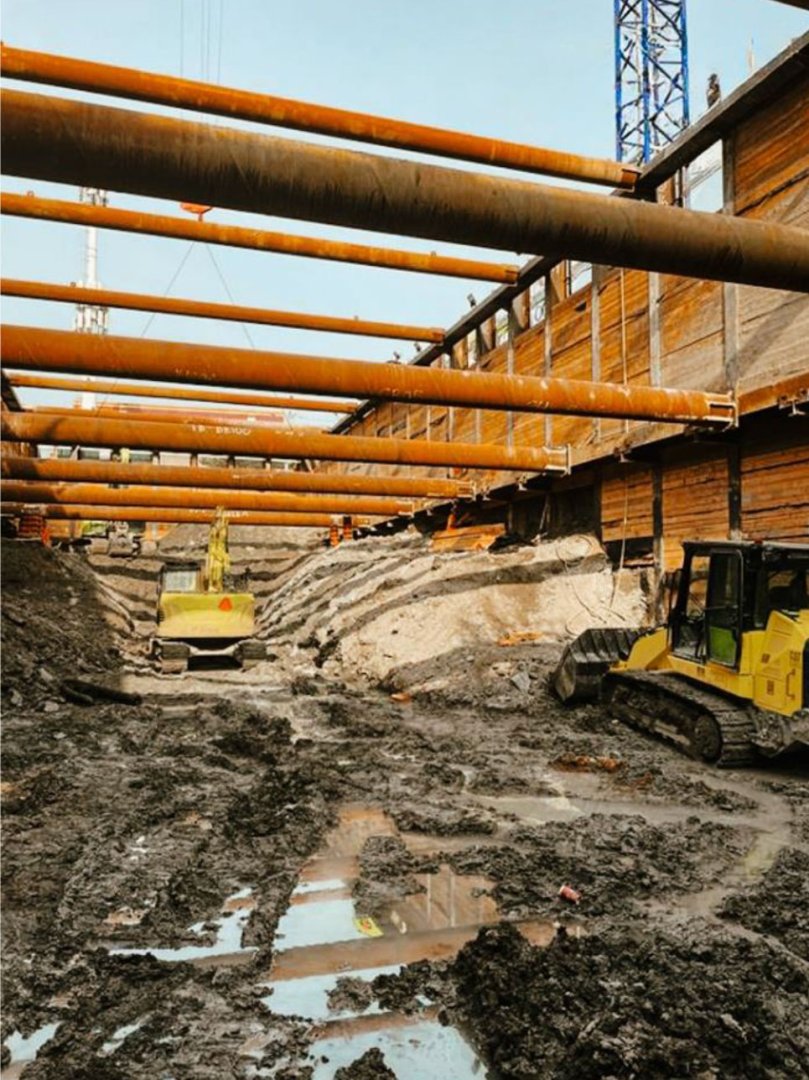
Delivering excavation support for stations of this scale involved a number of unique challenges.
Constructability
The first challenge was constructability. The initial designs for the support systems were structurally sound but included elements that would have been difficult to fabricate and install within the congested downtown environment. Beams weighing 35–37 tonnes needed to be lowered into place at significant depths. Site access was limited, and crane availability was restricted by both space and urban logistics.
Time
The second challenge was time. The Ontario Line is a high-profile project with immovable deadlines that had to be hit to keep the project progressing smoothly. Delays on the temporary SOE work could have carried a direct impact on the permanent structures. The project team needed a system that could be installed quickly and predictably, with as little fieldwork as possible.
Welding
The third challenge was welding. The original designs relied heavily on field welds, which introduced challenges that come with performing work in uncontrolled environments, such as weather dependency, additional inspection requirements, and higher demand for skilled labour, leading to increased labour costs. On a project of this scale, hundreds of meters of welding could easily add weeks to the schedule.
Taken together, these challenges highlighted our client’s need for a more efficient system that could be fabricated off-site, delivered ready to assemble, and installed without unnecessary complexity.
infraMOD’s Approach
Reviewing Existing Designs
infraMOD began with a detailed review of the existing designs. Our team of specialists analyzed the requirements and identified opportunities to simplify connections, reduce the number of components, and create modular assemblies that could be pre-fitted before shipping.
Applying infraMOD Methodology
By applying our methodology, infraMOD converted welded joints to bolted connections, improving both constructability and predictability. Bolted connections not only speed up installation but also allow for easy adjustments on site without cutting or welding.
Trial Assembly
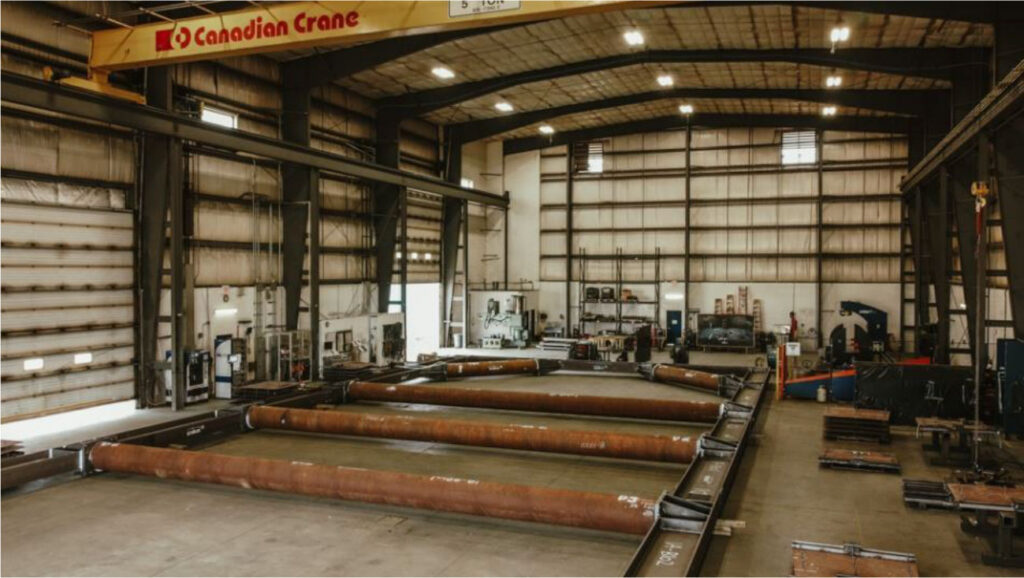
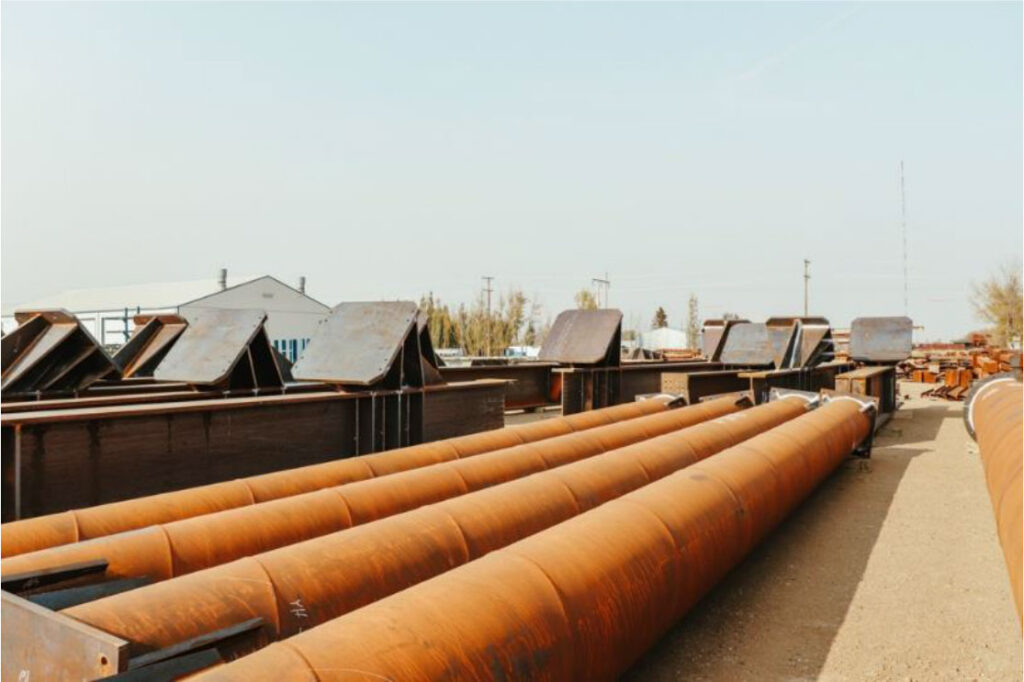
A key part of our approach is trial assembly. Thanks to our 95,000 square feet of fabrication space and 25 acres of laydown space, the major waler and strut systems could be assembled at infraMOD’s fabrication facility before shipping. This ensured proper fit-up and gave both infraMOD and the construction team full confidence that installation would proceed smoothly. By eliminating uncertainty, excavation could continue sooner and with reduced risk of delay.
Close Collaboration
infraMOD worked closely with our client’s construction team and engineers throughout the process. Instead of treating design and construction as separate stages, the teams collaborated to ensure that structural requirements aligned with practical installation methods. This partnership allowed challenges to be resolved quickly and gave the project team reliable solutions at each step.
Support & Site Assistance
Finally, infraMOD provided installation support and site assistance to make sure systems were placed safely and efficiently. Our role was not limited to fabrication; infraMOD was an active partner in ensuring the systems performed as expected in the field.
infraMOD™ SOLUTION
The advantages of infraMOD™ became most visible when comparing station sites.
At King Bathurst and Queen Spadina, modular assemblies arrived on site ready to install. Crews were able to lift and place beams within hours. Struts that might otherwise have taken days of welding and adjustment were installed in three to four hours. Entire assemblies were installed the same day they were delivered, dramatically accelerating the excavation schedule.
At Corktown, by contrast, a more traditional welded system was used. Although structurally effective, this method required significantly more site activity. Beams were cut, aligned, and welded in place. Welds had to be inspected and sometimes reworked. Weather interruptions slowed progress further. While the system met its engineering requirements, the added time and effort clearly highlighted the efficiencies gained by using infraMOD™.
This side-by-side comparison provided a clear measure of value. Modular systems not only reduced installation time but also removed many of the risks associated with weather, labor, and access.
Project Outcome
The Ontario Line stations supported by infraMOD™ solutions delivered several measurable outcomes:
- Excavation work started weeks earlier than originally scheduled, relieving pressure on critical path activities.
- Installation timelines were shortened from weeks to days, even for assemblies with components weighing more than 35 metric tonnes.
- No significant fit-up issues occurred thanks to trial assemblies and detailed quality checks, with some sites reporting absolutely no challenges during installation.
- Contractors could focus their crews on the permanent works, confident that the temporary systems were safe and efficient.
Client Verified Results showing the results of our infraMOD™ optimization for the Queen Spadina North Station:
Original: Issued for Construction Design
Level A – Estimated/Planned 42 Shifts
Level B – Estimated/Planned 63 Shifts
infraMOD™ : infraMOD™ Design Methodology
Level A – Actual 22 Shifts (learning curve included)
Level B – Actual 9 Shifts
Total Reduction of 74 shifts at a cost of $15,000/shift.
Net Savings of $1,110,000 for this excavation
For our client, infraMOD’s involvement meant they had a partner committed to problem solving and collaboration. Instead of delivering a system “as drawn,” infraMOD delivered a system that was optimized for installation and project success.
LESSONS LEARNED
Close Collaboration
One of the main takeaways from the Ontario Line project was the value of early involvement. Engaging infraMOD during the design stage allowed the project team to move beyond theoretical solutions and develop systems that worked in practice. This avoided redesign cycles, saved time, and reduced unnecessary complexity before fabrication even began.
Importance of Focus & Rigor
Another key lesson was the importance of treating temporary works with the same rigour as permanent structures. Too often, temporary systems are seen as secondary. On this project, infraMOD’s strict fabrication standards, inspections, and trial assemblies ensured performance, safety, and reliability. The systems were not just temporary, they were essential to the success of the permanent works.
Modularity as Strategy
Finally, the project reinforced the idea that modularity is not just about convenience. It is a strategy for risk reduction. By standardizing connections, simplifying logistics, and reducing field welding, infraMOD™ gave our clients a predictable and repeatable process that worked across multiple stations with consistent results.
Conclusion
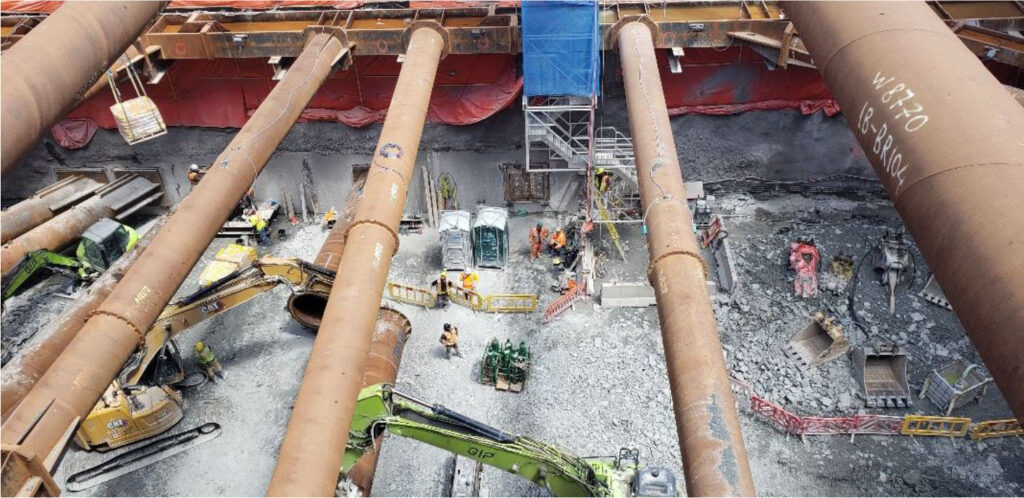
The Ontario Line required speed, precision, and efficiency. infraMOD’s methodology delivered all three. By transforming complex designs into modular, constructible systems, we helped our customer regain time, control costs, and stay on schedule.
This project demonstrated that infraMOD™ is more than a fabrication method. It is a partnership approach that combines engineering expertise, constructability, and practical solutions to deliver better outcomes.
For the customer, the result was a reliable system that performed as intended. For infraMOD, the project reinforced the value of early involvement, modular design, and close collaboration.
As infrastructure projects continue to grow in scale and complexity, the Ontario Line stands as a strong example of how infraMOD’s approach shortens project timelines, minimizes risk, and guarantees the lowest total installed cost. By engaging infraMOD early and leveraging our methodology, project teams can count on temporary steel works that are safe, efficient, and built with the end goal in mind.